

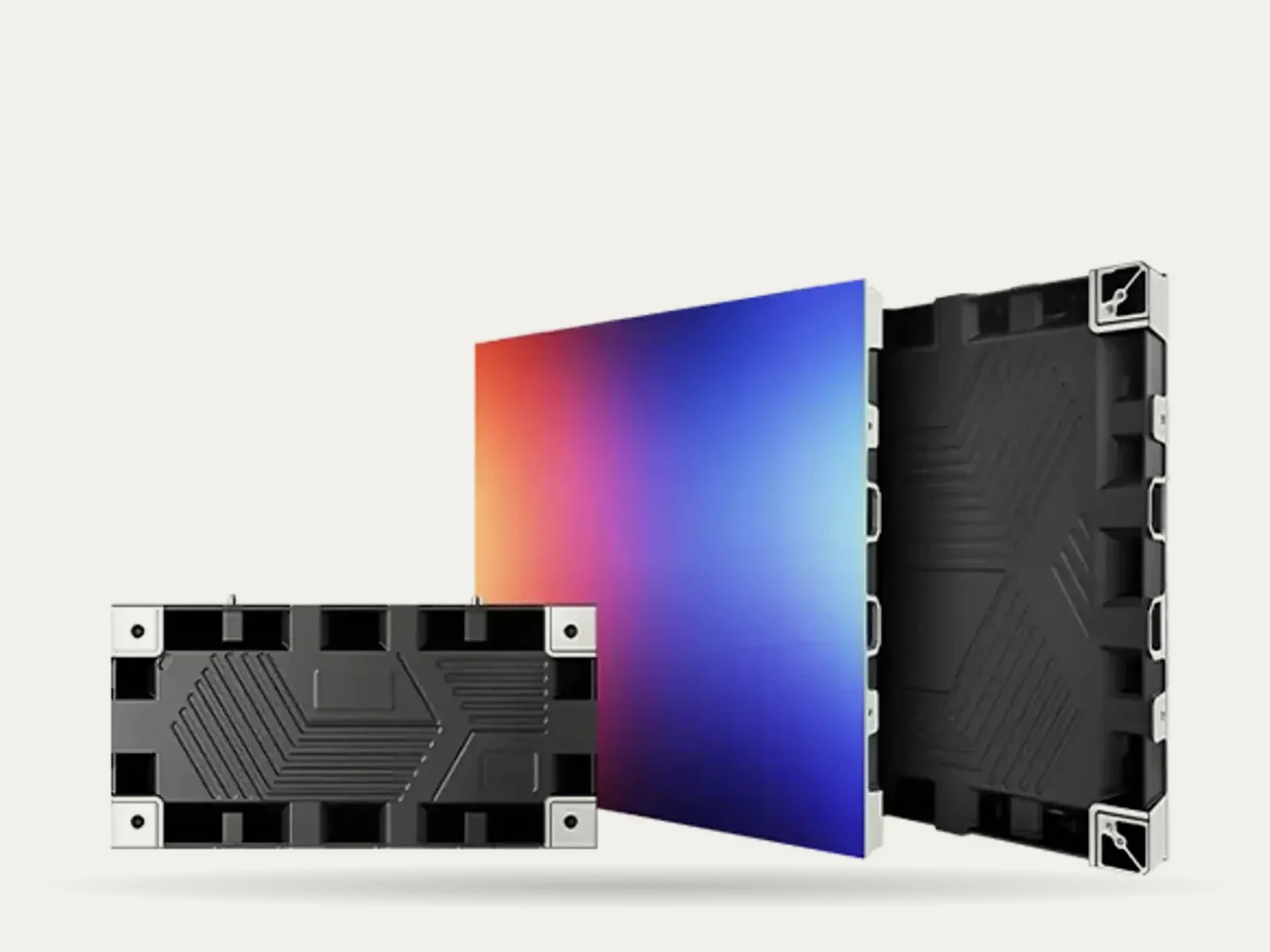
 Indoor LED wallsAn image that fills the whole room. Fixed-mounted LED walls turn foyer, shop and hall into a stage for your content, with 0.93 to 4 mm pixel pitch.
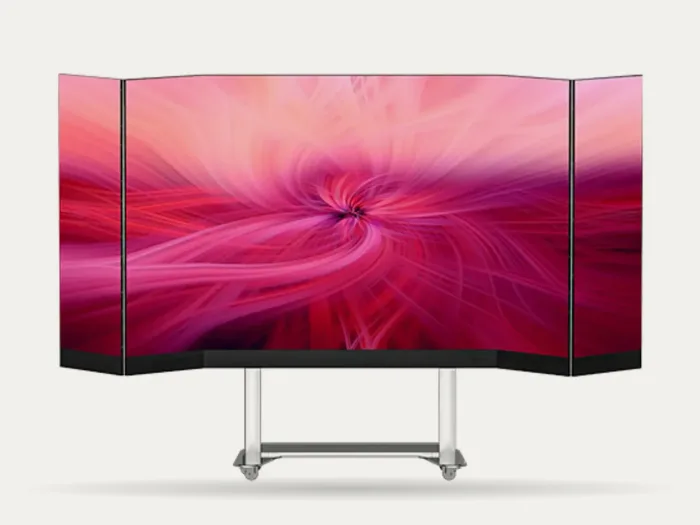
 All-in-one LEDA large image without a large technology project. All-in-one LED screens with built-in player, ready configured and almost as easy to operate as a television.




The difference in one sentence
A projector throws light onto a surface, and the surface throws it back. An LED wall generates the light itself, in every single pixel. Almost everything else follows from this: brightness, contrast, shadows and how it copes with room light.
Why room light matters so much
With projection, room light adds to the image. Black then turns grey, colours turn pale. An LED wall is dark where it should be dark, and bright enough to compete with daylight.
A worked example shows the order of magnitude. A projector with 5,000 lumens on a 10 m² screen gives around 160 cd/m² with a normal white screen. An indoor LED wall usually delivers 600 to 1,500 cd/m². For an equally bright image, the projector would therefore need many times the lumens. More on the unit under cd/m².
The comparison
| Feature | LED wall | Projector |
|---|---|---|
| Brightness | usually 600–1,500 cd/m² indoors, 5,000 and more outdoors | strongly dependent on lumens and image size |
| In daylight | easy to read | washed out, room must be darkened |
| Contrast | very high, true black | drops with any room light |
| Shadows | none | yes, when someone steps into the image (except rear projection) |
| Image size | made of modules, any size possible | very large with little effort |
| Space required | flat on the wall | projection distance needed |
| Continuous operation | built for it | light source ages, laser usually around 20,000 hours |
| Mobility | complex, only as a rental system | light and quick to set up |
| Purchase | significantly higher | significantly lower |
You can find guide values for LED walls under What does an LED wall cost?.
When what fits
The LED wall fits if …
- there is daylight in the room or the surface is in a shop window or outdoors
- the image runs many hours a day, for example in a lobby, sales room or reception
- people stand in front of the surface or walk past it
- the image is meant to be part of the room, not just a presentation tool
The projector fits if …
- the room can be darkened, for example a cinema, lecture hall or seminar room
- the image is only needed for a few hours at a time
- very large surfaces are to be used at short notice, for example projection mapping on façades in the evening
- the budget is small and flexibility counts
What speaks against it
LED wall: The purchase cost is significantly higher. It needs control, substructure and power. And it is permanently mounted: if you need the image in changing locations, you are better off renting, see Rent LED wall.
Projector: Against daylight every projector loses. More lumens only help up to a point, then the device gets loud, hot and expensive. With front projection, anyone standing in front of the screen casts a shadow. Short-throw projectors and rear projection solve this in part, but need suitable screens and space.
Middle ground: For bright rooms with a medium image size, a large LCD display or a LCD video wall can also fit. You can find the comparison under LED wall or LCD video wall?.
Our recommendation
We advise on a brand-independent basis and will also tell you when a projector is enough. The decision is usually made by looking at the room: where does the light come from, how far away do people sit, how long does the image run? We bring LED modules to the appointment. That way you see directly how the image looks in your light.
You can find projectors and screens under Projectors, LED walls under Indoor LED wall and Buy LED wall.